Enquiry Guides
Start a Wire Mesh Enquiry With Drawings or Photos
A first enquiry connects the component, its installation and the details you already know. An engineering specification is not always the starting point.
Start with the component itself, not with a specification sheet. Send a drawing or clear photographs of the complete part, add the dimensions you already know with their units, and say plainly which details are still unknown. That first message opens the technical discussion.
A replacement screen that looked right in a catalogue and still will not seat in the frame is the usual cost of starting from a part number.
This guide suits a buyer who holds an existing screen, basket, belt or cylinder and needs a replacement or a close match. It does not suit a buyer who needs a finished design drawn from nothing.
After reading it, you will know what to photograph, what to measure and what to write. It will not replace the technical review that confirms whether a construction suits your equipment.
When the replacement arrives and does not fit
You order a replacement screen for a machine that has run for years. The panel arrives, the mesh looks right, and the edges do not match the frame. The old screen goes back on, the line waits, and the second order starts from the same thin information as the first.
The same thing happens with a filter basket. The rim looks the same in a photograph, the seating depth is different by a few millimetres, and the basket rocks in its housing instead of sealing. Nobody measured the seating rim, because nobody photographed it.
A conveyor belt fails the same way. The belt surface matches, the joining area does not, and the drive connection is a different shape. The belt cannot be fitted, and the enquiry that produced it never asked for a photograph of the joint or the drive.
In each case the buyer did send something. A close photograph of the mesh, a part number from a worn label, a single measurement without a unit. The information was real, and it was the wrong information: it described the surface, not the part that has to fit.
Why the first message goes quiet
A supplier cannot quote a component it cannot identify. A mesh photograph shows the surface, but the decision needs the outline, the edges and the way the part mounts. When those are missing, the reply is a list of questions, and the enquiry waits for a second round of photographs.
The first gap is usually the reference. Several screens, baskets or cylinders in one plant can look alike and differ in one dimension or one connection. Without a name or reference for each component, a quantity and a specification can end up attached to the wrong part.
The second gap is the drawing version. A revised drawing and an old photograph can both be in the file, and the review cannot tell which one governs. Mark the change on a copy of the drawing, or describe it separately, and name the version you want reviewed.
The third gap is the installation feature. A screening panel is held by its mounting edges, a cylinder by both ends, a basket by its seating rim, a belt by its edges and joining area. A photograph set that shows only the mesh surface leaves out the very features that decide whether the part fits.
The fourth gap is the measurement without a basis. A value without a unit cannot be used, and a length without named measuring points cannot be checked. For a belt length or pitch, an annotated photograph can explain the measurement basis better than a bare number.
The fifth gap is the missing application. A screen that separates aggregate, a basket that strains a liquid and a belt that carries hot material are different enquiries, even when the mesh looks the same. Without the application, the working conditions and the quantity, the discussion has no frame to judge a construction against.
Decide what your enquiry is before you send it
If you have a drawing, send that first. Name the version you want reviewed, and mark any proposed change directly on a copy, or describe the change separately. A drawing with a version and a marked change is a reference the review can work from; a drawing without either is a guess.
If you have the old part, photograph the whole component before any detail. Start with an overall view, then the features that explain installation: mounting edges on a screening panel, both ends of a cylinder, the seating rim on a basket, the edges and joining area on a conveyor belt.
If you have only a sketch, make the sketch do the work of a drawing. Show the overall dimensions and the important connections, write the units beside every value, and make clear which points were measured. A simple sketch with units and named measuring points is more useful than a polished drawing with none.
If you are enquiring about several parts, give each component a name or reference and keep its drawings and photographs together. Identify which quantity and specification belongs to each one. Several screens or baskets can look similar and still differ in dimensions or connections, and a mixed file is where the wrong specification gets attached to the wrong part.
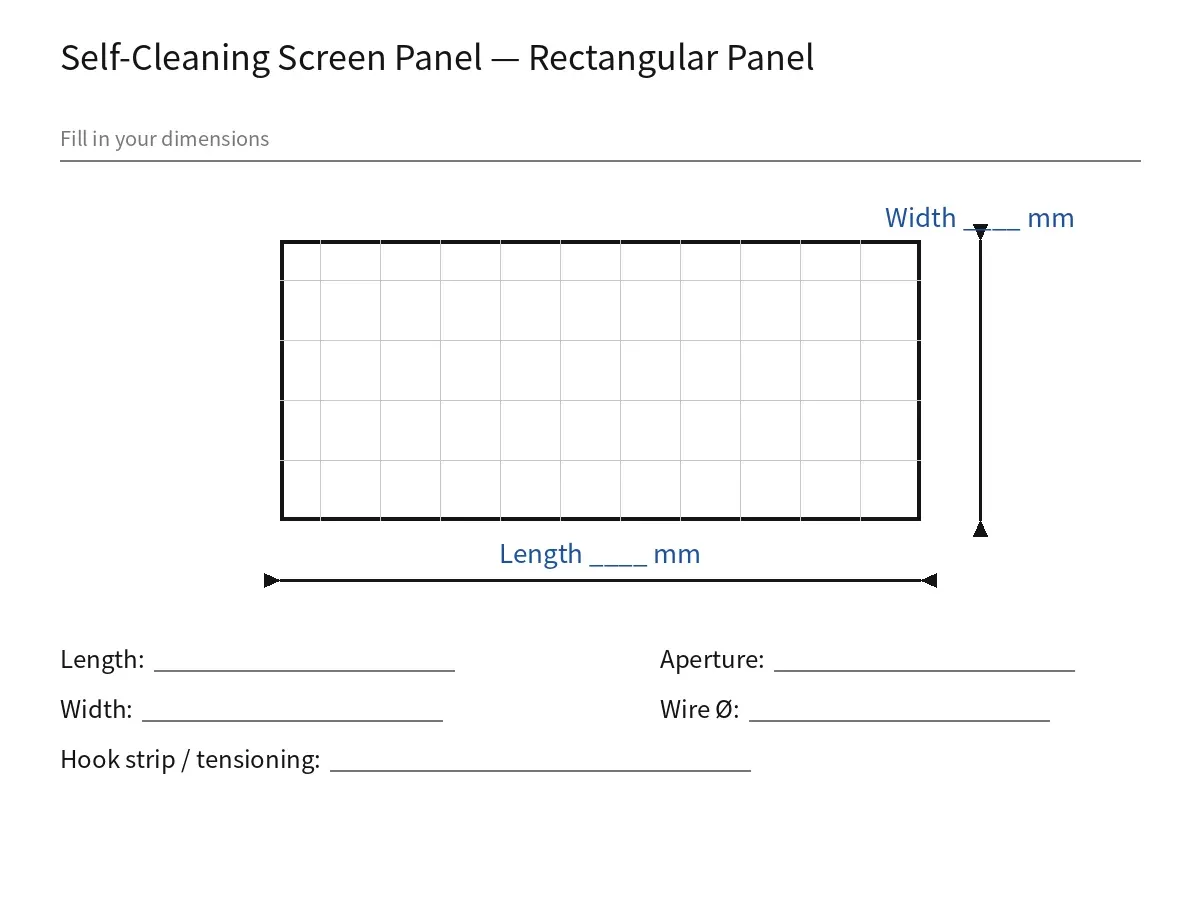
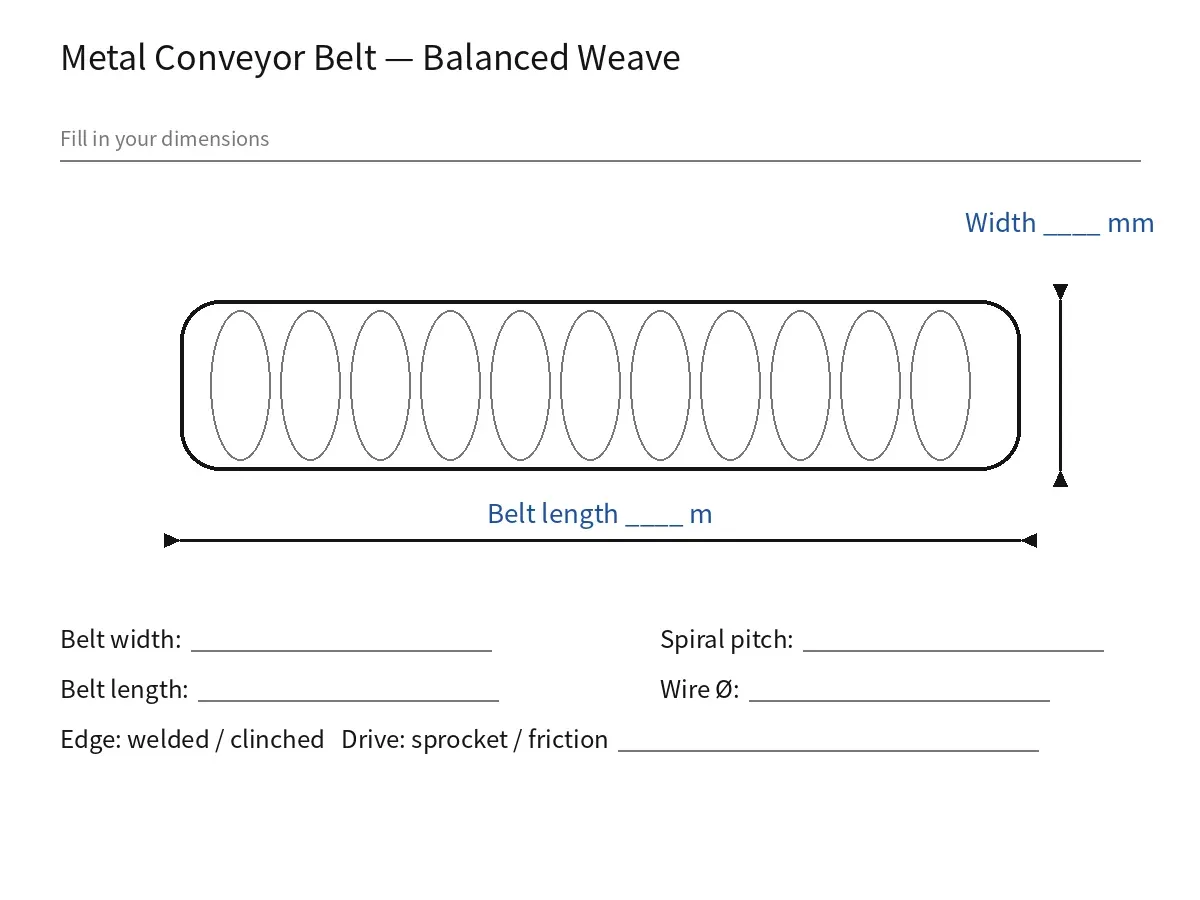
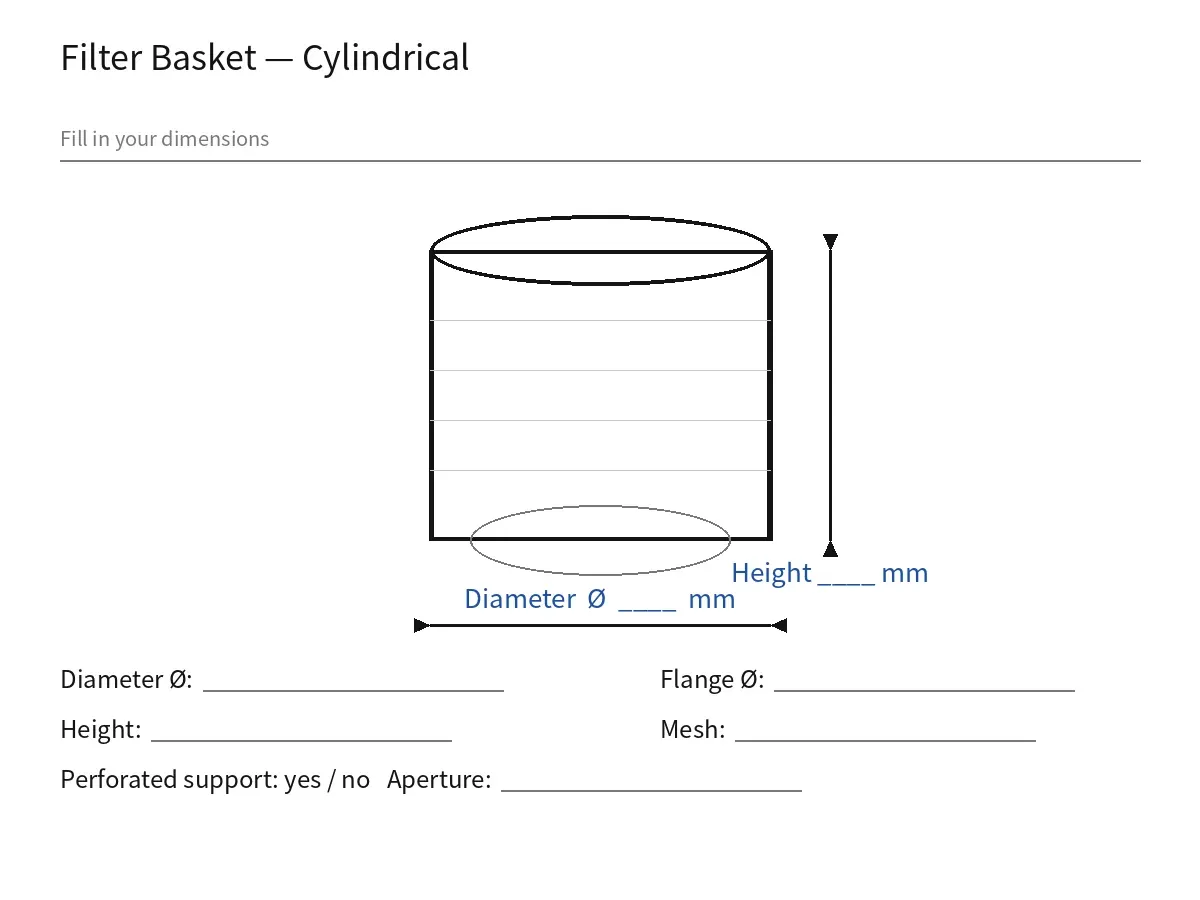
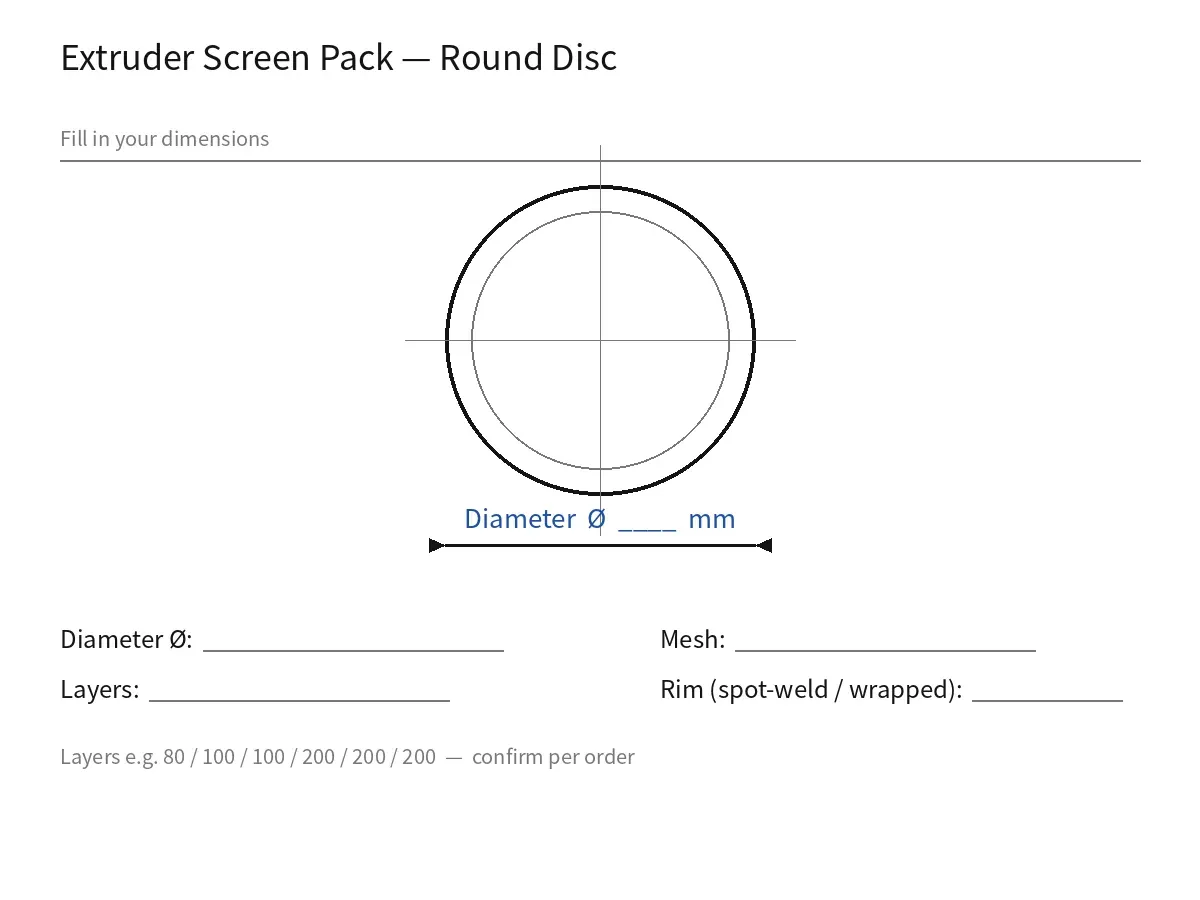
Use the worksheet for your product type. There is one for extruder screen packs, self-cleaning replacement screens, conveyor belts, filter baskets, wedge wire panels and cylinders, and filter cylinders and cones. Each worksheet lists ten numbered fields, and you complete only the fields you know, leaving the rest blank.
Keep an existing mesh, slot or filtration specification in its original wording. If a detail is unknown, say so in the enquiry. The first message does not need a guessed material grade, mesh count or filtration rating to look complete, and a guessed value can send the review in the wrong direction.
Match the photographs to the product. A self-cleaning screen needs a full-panel view, the surface pattern and the fixing edges, with the support strips shown where they sit. A wedge wire panel needs the working face, the reverse supports and the frame, with the working side and flow direction noted.
A filter cylinder needs the full body, both ends and the connection. A basket needs the complete basket and the seating area, including the rim, handle and bottom. An extruder screen pack needs the complete screen and its side profile, so the layer arrangement and the edge construction can be seen.
## What this approach cannot do
A drawing or a photograph does not decide suitability by itself. Whether a construction suits your equipment is confirmed after technical review, against the installation, the application and the working conditions you describe. The first message starts that review; it does not finish it.
Do not fill a gap with a guess. A material grade, a mesh count or a filtration rating written in to make the enquiry look complete can mislead the review more than a blank field. Write unknown where the detail is unknown, and let the review ask for the one measurement that actually decides the construction.
A machine model alone may not identify the replacement. Two machines of the same model can carry different screens, and a model name without photographs or dimensions leaves the review with nothing to match against. Send the part, not only the machine it came from.
A close photograph of the mesh surface is useful, but it does not replace the whole-part reference. If there are separate filtering and supporting layers, show how they fit together. Identify any view taken from a different component, so a detail from one part is never read as a detail of another.
What this approach cannot do
This guide does not cover a finished design drawn from nothing. If no part, drawing or sketch exists yet, the enquiry needs a different starting point: the equipment, the opening it must cover, and the material it must handle, described before any component is named.
Send the first message tonight
Gather the reference tonight. Name the component, collect its drawing and photographs in one place, and check the version on the drawing. If a blank dimension drawing is available for your product type, fill in the values you know and leave the rest empty; it is a tool for the enquiry, not a test.
Write the short description next: what the component does, where it sits, and the material or medium involved. Add the working conditions you already know, the quantity you need, and whether the request repeats the existing construction or changes it. Keep it to the facts you have.
Send it to Anping Mesh Pro at sales@anpingmeshpro.com, with the drawing or photographs attached and the worksheet completed for the fields you know. Or use the Custom Wire Mesh Enquiry form, which asks for your name, email, product or application and a brief requirement, and company, quantity, known dimensions, target market, trade terms or requested delivery date you can add.
The next discussion can then focus on the remaining details needed for the individual quotation. Leo Li will reply within 1 working day. Start with the drawing or photographs you have, and the review will ask for the rest.