
Extruder Screens and Screen Packs
Custom Extruder Screens and Screen Packs
Discuss wire mesh screens and multilayer screen packs for your melt-filtration requirement. Send the shape, main dimensions, quantity and any known layer or edge details.
Specifications
- Mesh count
- 4–500 mesh; square-mesh work commonly 20–150 mesh (18 mesh ≈ 1000 µm; 500 mesh ≈ 25 µm)
- Layers
- 1–5 layers (multilayer packs commonly 2–5)
- Disc diameter
- 5–900 mm
- Ring
- ID 18–250 mm / OD 50–350 mm
- Rectangle
- 60 × 50 – 400 × 100 mm
- Oblong
- 60 × 80 – 90 × 170 mm
- Dutch weave
- Up to 1800 mesh; absolute rating down to 5 µm (200 × 1400)
- Materials to discuss
- 304 / 316 / 316L, 201, nickel alloy, Hastelloy and others — by application
Extruder screens and screen packs, made to your melt-filtration duty
The challenge
Melt purity decides the quality of the final product. When unmelted residue, gels or foreign matter get through, differential pressure across the screen pack rises, the pack has to be changed sooner, and the line stops more often.
That is the problem a screen pack is there to solve: hold the filtration level steady through the run, so pressure stays stable and changes happen on plan, not mid-shift.
Our approach
We supply custom extruder screens and screen packs from Anping, China. Each pack is made to order: the mesh combination, number of layers and edge construction are matched to the extruder's breaker plate / screen changer and to the melt being filtered.
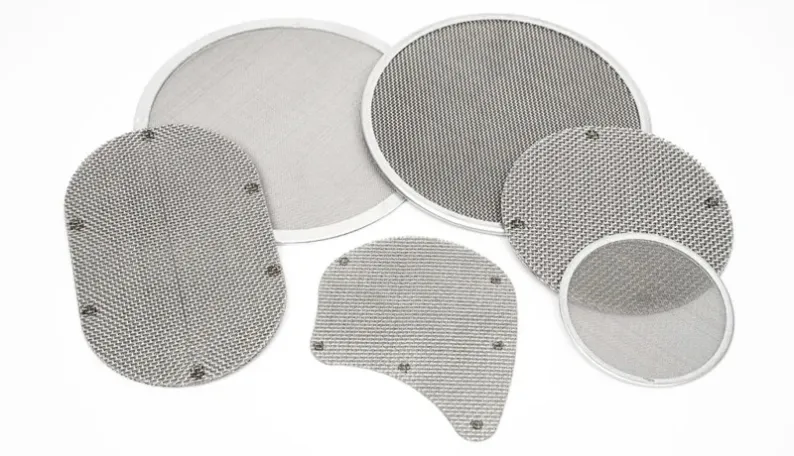
Forms we discuss with you (pick the one closest to your current part):
- Single cut screen — one layer, cut to shape.
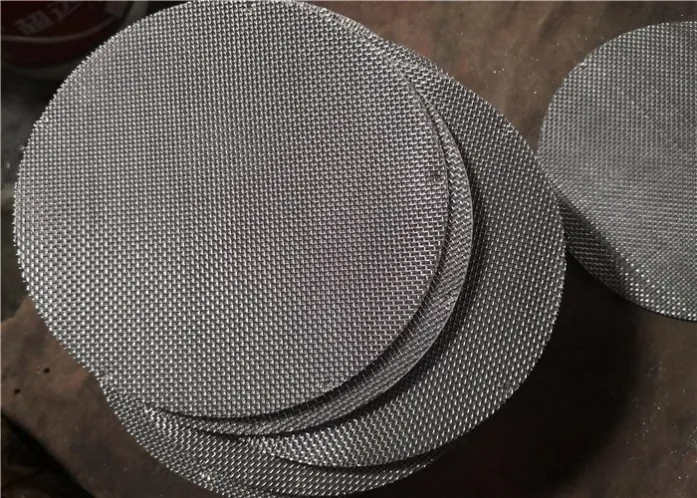
- Spot-welded pack — several layers joined at points, so the stack goes into the changer as one piece.
- Edged pack — layers held in a defined edge construction.
- Cylinder, cone and pleated packs — for housings and continuous melt-filtration setups where a flat disc does not fit.
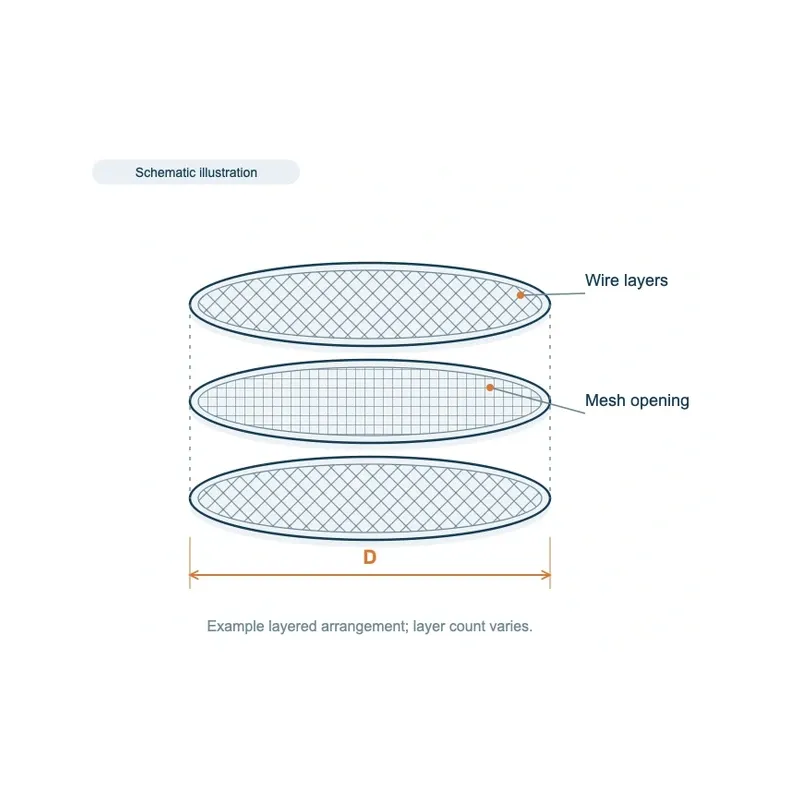
Layer logic, in plain terms: a coarser support layer carries the pack, finer layers do the filtration, and the layer sequence is set by the filtration level you need and the pressure your changer can take. Dutch weave is the option when the duty needs a finer absolute rating than a square-mesh combination can give.
Typical range
Final specification is confirmed per order / drawing. The ranges below are industry-common values from public supplier pages — they show what to discuss, not what we promise off the shelf.
Mesh count: 4–500 mesh; square-mesh work commonly 20–150 mesh (18 mesh ≈ 1000 µm; 500 mesh ≈ 25 µm)
Layers: 1–5 layers (multilayer packs commonly 2–5)
Disc diameter: 5–900 mm
Ring: ID 18–250 mm / OD 50–350 mm
Rectangle: 60 × 50 – 400 × 100 mm
Oblong: 60 × 80 – 90 × 170 mm
Dutch weave: Up to 1800 mesh; absolute rating down to 5 µm (200 × 1400)
Materials to discuss: 304 / 316 / 316L, 201, nickel alloy, Hastelloy and others — by application
How to read mesh count: aperture (mm) = 25.4 ÷ mesh count − wire diameter (mm). A mesh count alone is not a filtration rating — send the original micron value with its description rather than converting it into a mesh count.
Sources for the ranges: BM Metal Mesh, Boedon, BH Filter, Xingkuan (Made-in-China / ecer public pages). Our factory-confirmed layer combinations and micron range are still pending — final specification confirmed against your drawing / sample.
What this helps with
- Steadier differential pressure — the pack holds its filtration level through the run instead of blinding early.
- Fewer unplanned changes — changes happen on plan, not because pressure spiked mid-shift.
- Longer intervals between changes — the right layer combination spreads the contaminant load instead of loading one layer.
No lifetime or pressure figures are promised here: the result depends on the melt, the contaminant load and the changer. The ranges in §3 and the questions in §6 are how we get to a pack that fits your duty.
Typical applications
- Virgin resin production — melt filtration on the polymer line.
- Compounding and masterbatch — screen packs for melt filtration on masterbatch, compounding and extrusion lines (the duty Colournext asked about for its customers).
- Plastics recycling — screen-pack performance and cost on recycled feedstock, where contaminant load is higher.
- Synthetic fibre / monofilament — fine filtration ahead of spinning.
- Blown film / specialty film — filtration where a gel or particle shows up directly in the film.
- Food-contact polymer filtration — 316L / 304 options discussed for food-contact duties.
Each application links back to the same enquiry: shape, dimensions, layer arrangement and the melt being run.
Next step
Send the information you already have — a drawing, photographs of the complete screen, its edge and its side profile, or a sample part. These seven questions are what we ask next (adapted from DWT's public selection questions — the questions themselves, not their wording):
1. Filtration level required (micron rating, with its original description).
2. Backflush or not — does the line backflush the pack?
3. Contaminant type and size — what has to be caught?
4. Target output — throughput the pack has to sustain.
5. Screen changer type and model.
6. Past failure details — how did the last pack fail (blinding, breakthrough, edge leak)?
7. Shape, main dimensions and quantity — disc / ring / rectangle, and how many per order.
Tools to send with your enquiry:
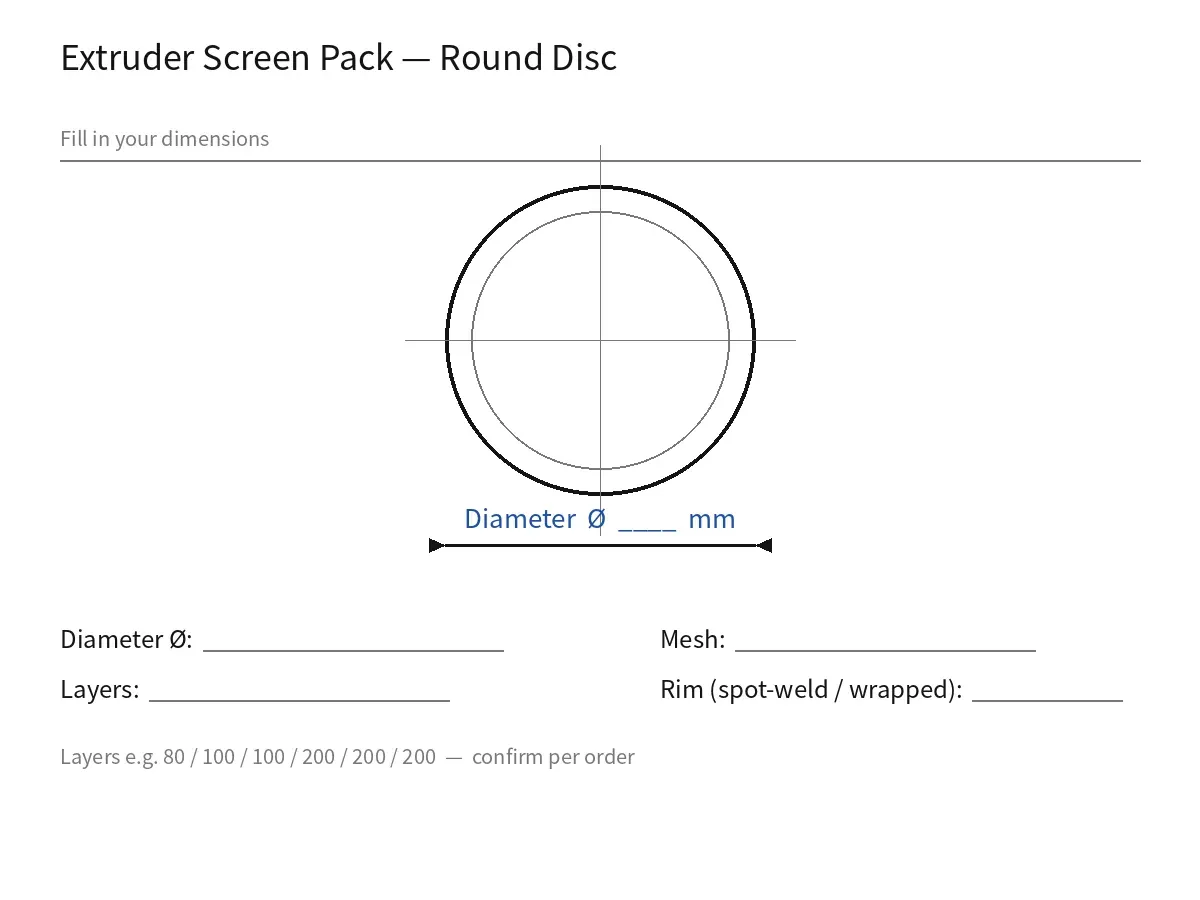
- Blank dimension drawing blank-dimension-P02-disc — fill in diameter, layers, mesh count and edge (spot-welded / edged) and send it back.
- RFQ sheet (P02) — the same fields as a PDF, for buyers who prefer a form.
- Sample — samples are available on request; availability, fee and lead time depend on the product, size and quantity — send your specification and we will confirm. Standard sizes can usually be supplied quickly; custom sizes are made to your drawing.
Enquiry email: sales@anpingmeshpro.com — or use the enquiry form. We reply with the next details needed before a quotation is prepared.
Customisation Topics
- Outline shape and dimensions
- Mesh and layer arrangement
- Layer joining and edge construction
- Quantity and packaging requirements
Questions About This Product
Can I enquire if I do not know the mesh-layer sequence?
Yes. Send clear photographs, a sample reference or any existing specification. Identify which details are known so the remaining construction can be discussed.
Should I describe a micron value as a mesh count?
Keep the original value, units and description. A mesh count and a filtration rating describe different information and should be reviewed in their original context.
What is useful to show in the photographs?
Show the complete outline, filtering surface, edge and side profile. These views help distinguish a single screen, a stack of screens and an assembled pack.
Discuss Your Requirement
Send a drawing or photographs of the complete screen and its side profile, with dimensions and quantity if known. Email drawings or sample photographs to sales@anpingmeshpro.com.